A Chip Bag, a Soda Can, and Five Miles at Idle
Five hours into a delivery, a hose let go. What got us home came out of the galley and the trash.
A 40-foot Holiday Mansion is not a fast boat. She is a floating apartment with an engine in the back, and on a good day she will make eight knots if you ask nicely. We were taking one from the Bay Area peninsula up into the Sacramento River, which is a long, patient run at the best of times.
Five hours in, crossing San Pablo Bay, she started making heat she had no business making.
What actually broke
The raw water hose failed first. That is the whole story, and everything after it is consequence.
Here is the part most people don’t know about boat engines. A car engine dumps its heat into the air through a radiator. A boat has no air to spare, so it pulls seawater or river water in through a hole in the hull, runs it through the engine, and then injects that water into the exhaust before pushing the whole mixture out the back.
That last part matters more than it sounds. Marine exhaust hose is rubber. Dry exhaust gas comes off an engine hot enough to destroy it in minutes. The only reason rubber survives back there at all is that it is being continuously cooled by the water travelling through it.
So when the raw water hose let go, it did not just stop cooling the engine. It stopped cooling the exhaust.
You have to respect the water. It has an uncanny way of stacking disadvantages against you.
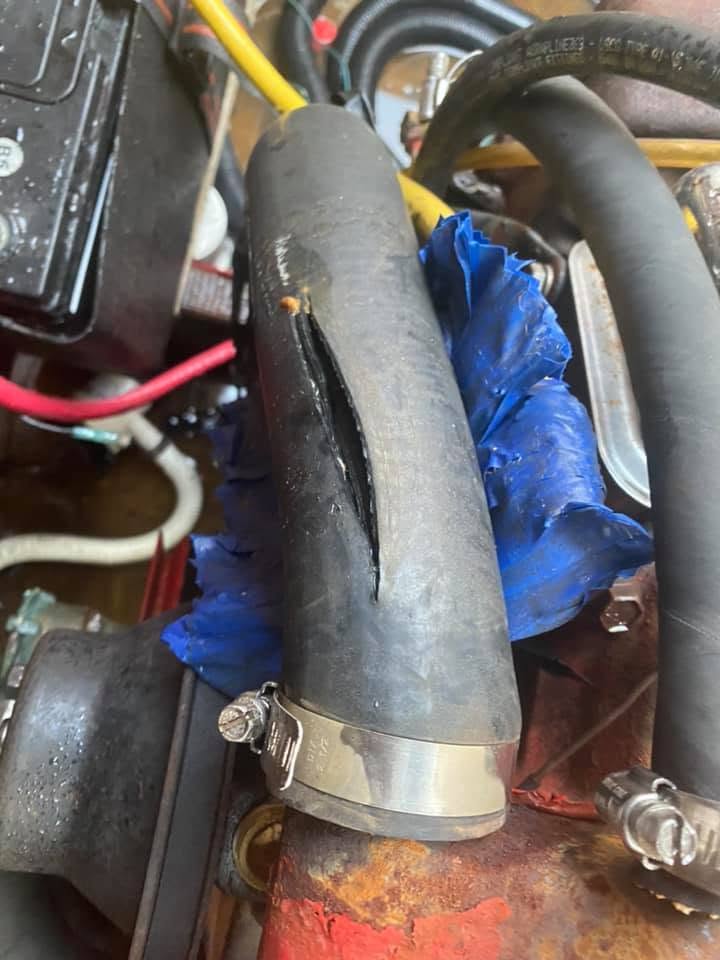
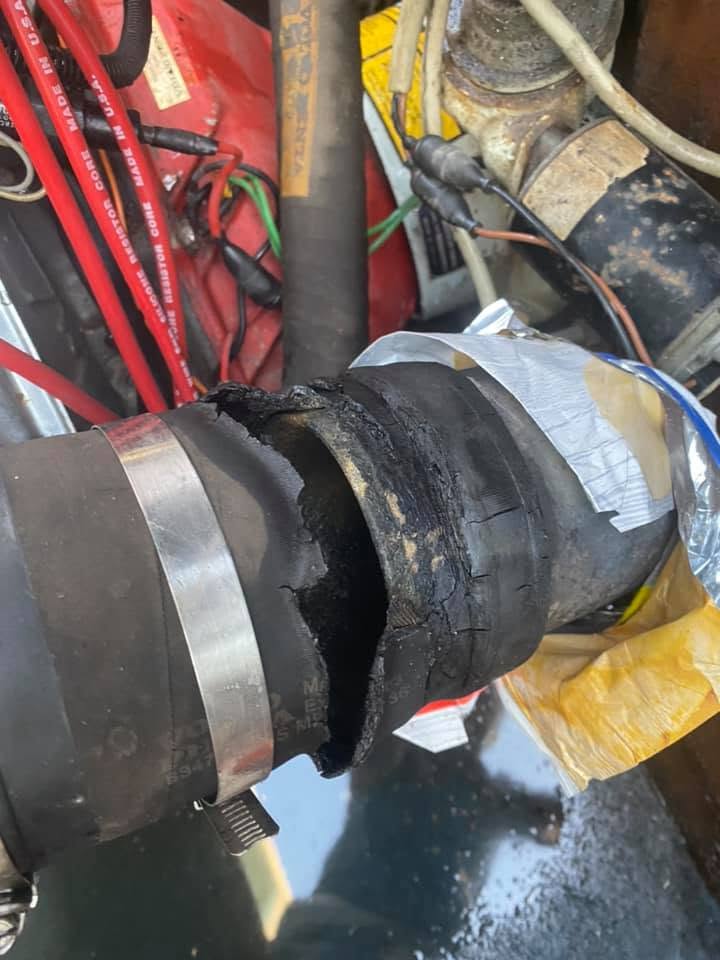
That hose is not split. It is burned. The rubber has gone to charcoal and crumbled, which tells you it cooked from the inside with nothing running through it to carry the heat away.
What I had to work with
Two things were broken, and they had to be fixed in order. Cooling water first, because without it nothing else matters. Then the exhaust hose the lack of cooling water had destroyed.
There was no parts bin. What there was: a galley, a roll of blue electrical tape, and a boat full of the ordinary things people leave aboard.
You switch quickly into MacGyver mode and use the resources well. It becomes less like a boat repair yard and more like being stranded on an island, or an Apollo 13 mission. This is what we have, and this should work.
The intake hose got the tape. That is not a repair anyone would sign off on, and it is not watertight—taped rubber under suction weeps, and it weeps the entire time the engine is running. But it moved water, and moving water was the difference between going home and going nowhere.
The exhaust hose needed something else entirely, because that side of the problem is about heat.
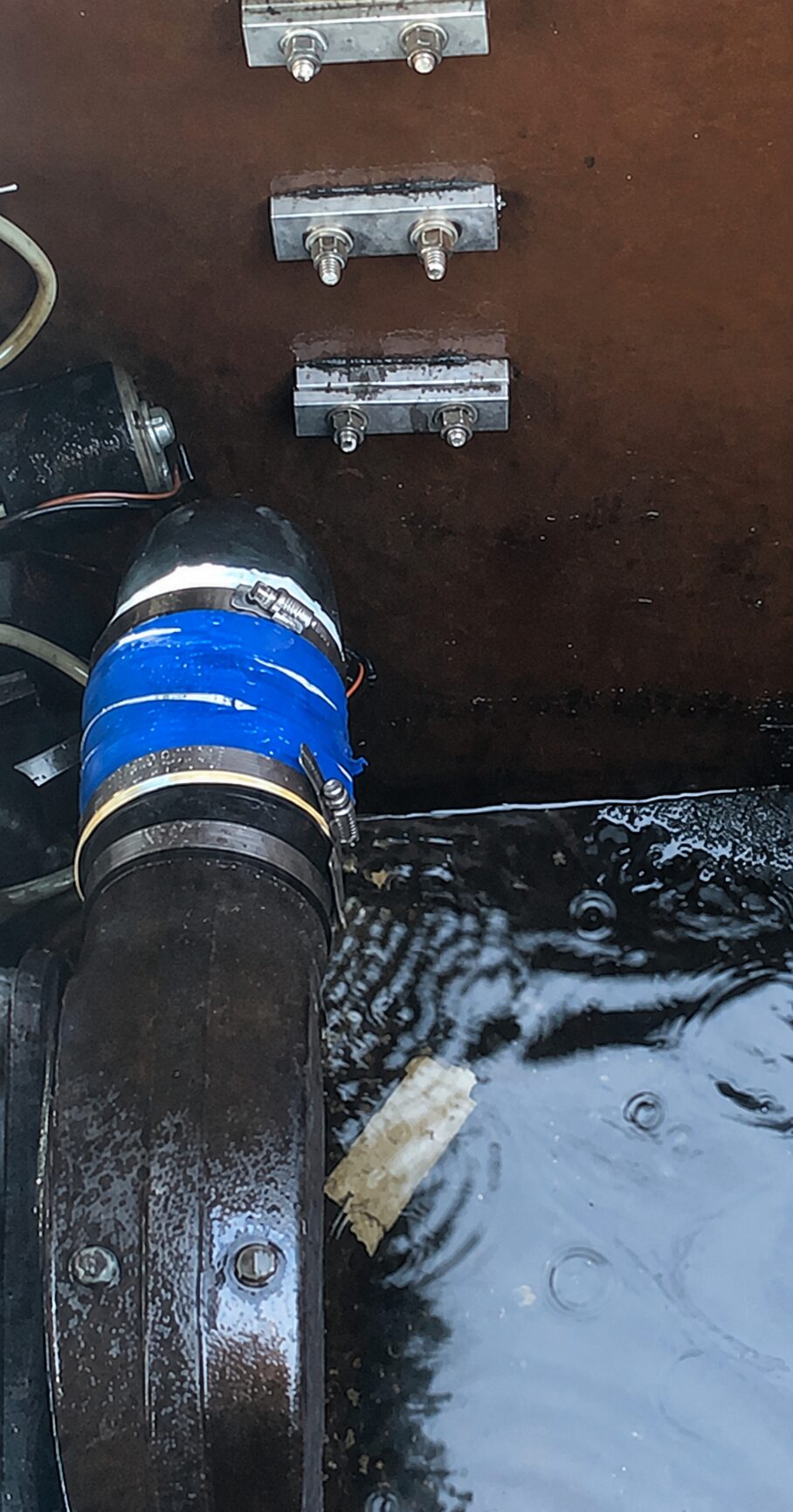
That patch came out of the trash and the cupboard, in three layers, and each one is doing a specific job.
A mylar potato chip bag went on first, foil side in. This is the part people laugh at, and it is the part that actually mattered. Ordinary tape on a hot exhaust turns to glue and runs. Mylar is a metallised film—it reflects radiant heat and it does not melt at the temperature that would destroy anything else I had. It was the only heat barrier aboard.
A soda can, cut open and flattened, went over that. Aluminium sheet gives you something the foil cannot: rigidity. Exhaust is not a steady push, it is a series of pulses, and a soft patch just breathes with them until it fails. The can turned a wrap into a sleeve.
Blue electrical tape and hose clamps held the whole thing in compression. The tape was never the seal. It was the thing holding the seal against the pipe.
Then the third problem
Both of those repairs leaked. They were always going to leak. Tape and foil do not seal a hose the way a hose seals a hose, and I knew that while I was putting them on.
So now I had cooling water reaching the engine and cooling water arriving in the bilge, continuously, for as long as the engine ran. Which is a problem with a clock on it.
There was a spare bilge pump aboard, with hose and an automatic float switch. I wired it in direct—bypassing the float entirely, so it ran without being asked—and let it throw the leak back overboard as fast as the repairs delivered it.
That is the part I want to be honest about. I did not fix that boat. I set up a system where three things were failing at a rate I could stay ahead of, and then I did not ask any of them to do more than that.
Then we idled five miles back to the dock.
The idling was not caution for its own sake. Less throttle means less fuel, less fuel means less exhaust heat and less exhaust volume, and both of those were exactly what my chip bag and soda can needed from me. The repair held because I stopped asking it to do more than it could.
What I take from it
People tell that story back to me as a story about tape. It isn’t.
Nothing in that engine room was the right part. What made it work was knowing what each wrong part was actually good for—that mylar is a heat barrier and not a tape, that a can is a structural material and not trash, that tape on a suction hose will weep and the question is only how fast.
And knowing that a repair does not have to be good. It has to be good enough, and you have to know exactly how it is going to fail, so you can put something in place to catch it when it does.
That is not resourcefulness in the inspirational sense. It is just knowing how things work, and then being willing to use that knowledge on a bad afternoon a long way from a chandlery.
A repair does not have to be good. It has to be good enough, and you have to know exactly how it is going to fail.
A repair Shaw makes in Vigilant came directly out of that afternoon on San Pablo Bay—different vessel, different stakes, same reasoning.
I did not have to invent it. I just had to remember it.
— Captain Nate